
We reached Hampi. I’m back here after 6 years. Our host at the guest house said we were “lucky fellows.” That’s because we unknowingly arrived in Hampi one day before Shiva and Parvati’s wedding. More than 100,000 devotees were expected to visit the town from various South Indian villages and cities. The whole place was buzzing with a festive mood.
It starkly contrasts how I saw Hampi on 23rd Nov 2017. It was quiet then. I had joined a guided cycling tour that time. About 20 people, mostly foreigners, spent the entire day in the ancient Vijayanagar kingdom, imagining its magnificence from its ruins. Yes, the same Vijayanagar where Tenali Rama attended Krishnadevaray’s court.

Hampi is situated on the banks of the Tungabhadra River and is home to the famous Virupaksha and Vitthala temples. The wedding procession was supposed to start from the Virupaksha temple at 9 pm tonight.
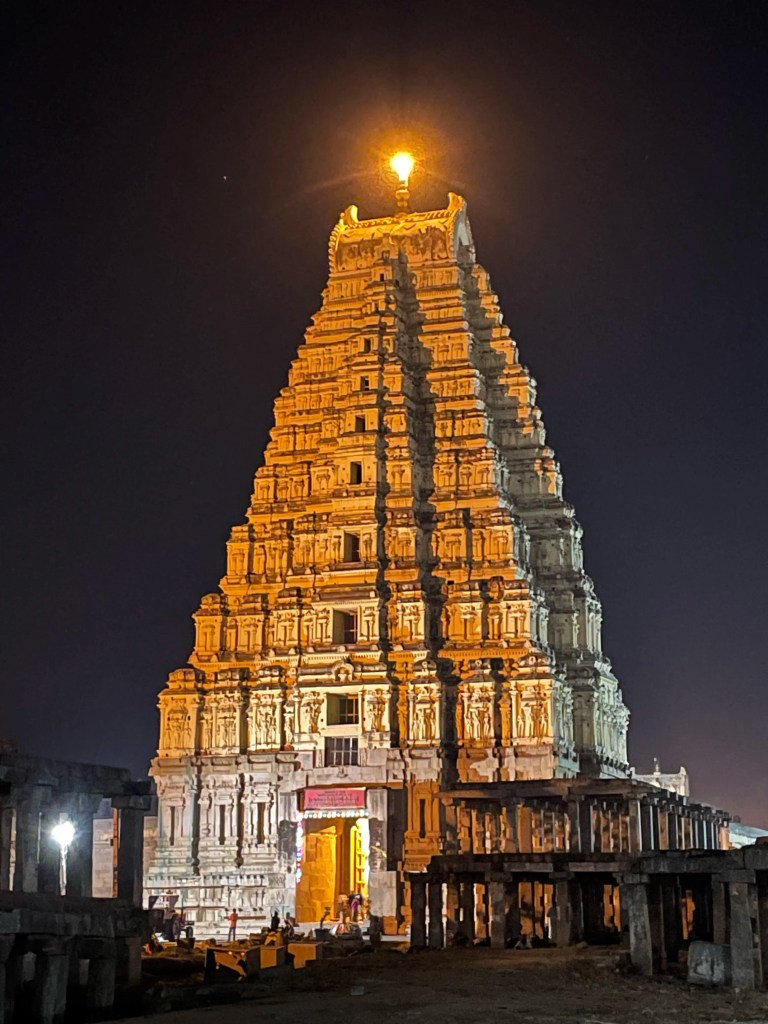
Now, a little bit of history. Hampi is not just the capital of one of the most prosperous kingdoms in the world, the Vijayanagar empire (1336-1565 CE). It is also believed to be Kishkinda, where the Vanaras (in Ramayana) had their kingdom. The pre-Vijayanagar period saw Jaina and Buddhist presence as well. During the Vijayanagar period, this place was one of the centers of Hinduism. This period saw four dynasties – Sangama, Saluva, Tuluva, and Aravidu. The initial years of Shaivism gave way to Vaishnavism during the later dynasties.
The empire was in constant wars with the Bahamani Sultanate (later Deccan Sultanates). Eventually, the Vijayanagar army was defeated by the combined forces of the Deccan Sultanates in the Battle of Talikota in 1565, leading to Vijayanagar’s end. All of its architectural marvels were trampled upon by the victors.
While exploring the ruins of this magnificent empire, I never saw Tenali Rama being mentioned anywhere. However, Krishnadevaraya still remains a local hero. The empire reached its peak under his rule. Several monuments that the Archaeological Survey of India excavated after 1976 were built by him. He built some commemorating his war expeditions, while others he built hold religious or economic importance. Even the Vitthala temple is believed to have been built during his reign.

Just like in 2017, the Hampi experience was eye-opening yet again. After a full day of exploring and learning, I couldn’t help but imagine how the festivals were celebrated during Krishnadevaraya’s times.
The streets were fully packed with devotees. Vendors, both men and women, were selling bangles, ornaments, puja items, sweets, and confectioneries, along with South Indian vegetarian snacks. Entering the temple complex was nearly impossible. The old and young alike walked barefoot. I continued to imagine the force of devotion bringing all these people to this small vicinity. I couldn’t relate to this devotion. I didn’t feel ‘lucky’ as our host had said. He had claimed all our life’s problems would be solved since we were here on this auspicious day. To this, my father questioned if this is applicable to Kolkata’s AQI.

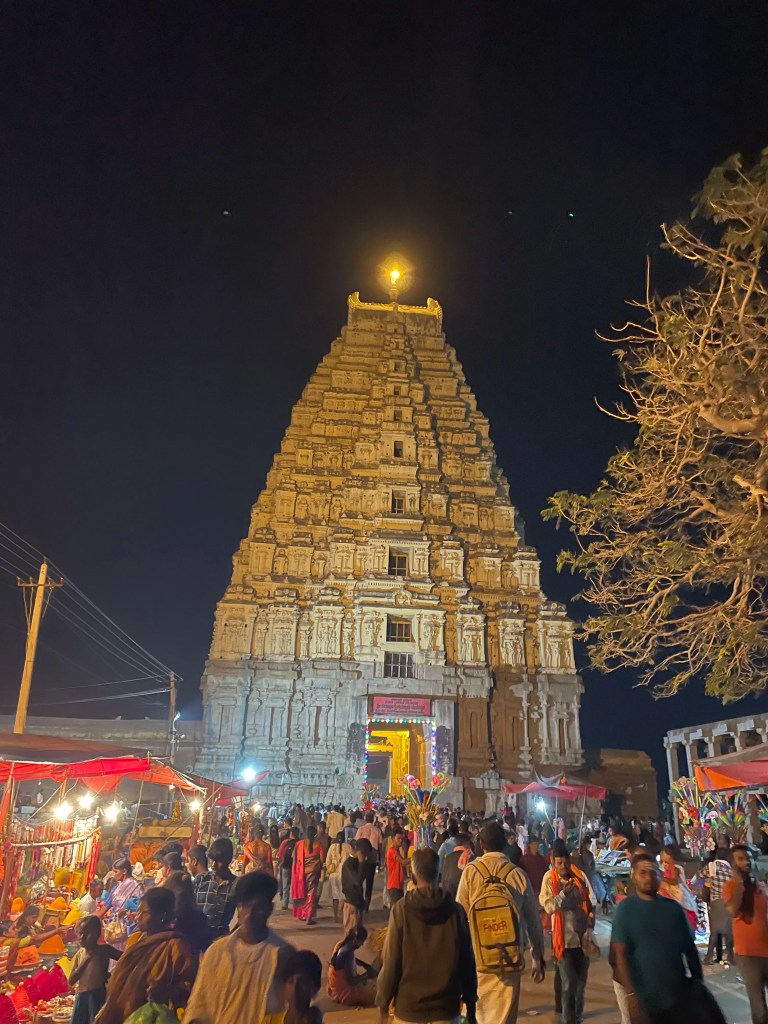

Religion or faith, or maybe fear, is an excellent glue that binds people from all walks of life. At 9:30 pm, I went towards the Virupaksha temple again to see what was going on. The procession had probably already left, so the crowd was thinner. On the street, I saw many variants of people. Not all were devotees. Some came here because others came. They wanted to enjoy the festival. Some came to do business. Some were here to manage the crowd. Some for shopping. A group of dudes (tourists) asked me to click their pictures with the temple and the crowd. A ~10-year-old boy asked me in broken English about my native town. Upon learning (Kolkata), he let me know that Virat Kohli-led RCB was the best IPL team.
Temples brought people close to each other. Hindu mythology has different gods in charge of different aspects of a person’s life. Interestingly, I found out that these temples thus enabled thematic congregation. For example, the place close to one of the Ganesh temples in Vijayanagar was used for education.
During my previous visit to Hampi, I had connected with a group of European tourists who were also keen to learn about this ancient Indian city. Unlike this visit, with its throngs of devotees, that time was quieter, more intimate. We were brought together by a subtle, perhaps less intense, religious curiosity. Interestingly, it was a contrasting, more formidable religious force that led to the downfall of Vijayanagar.
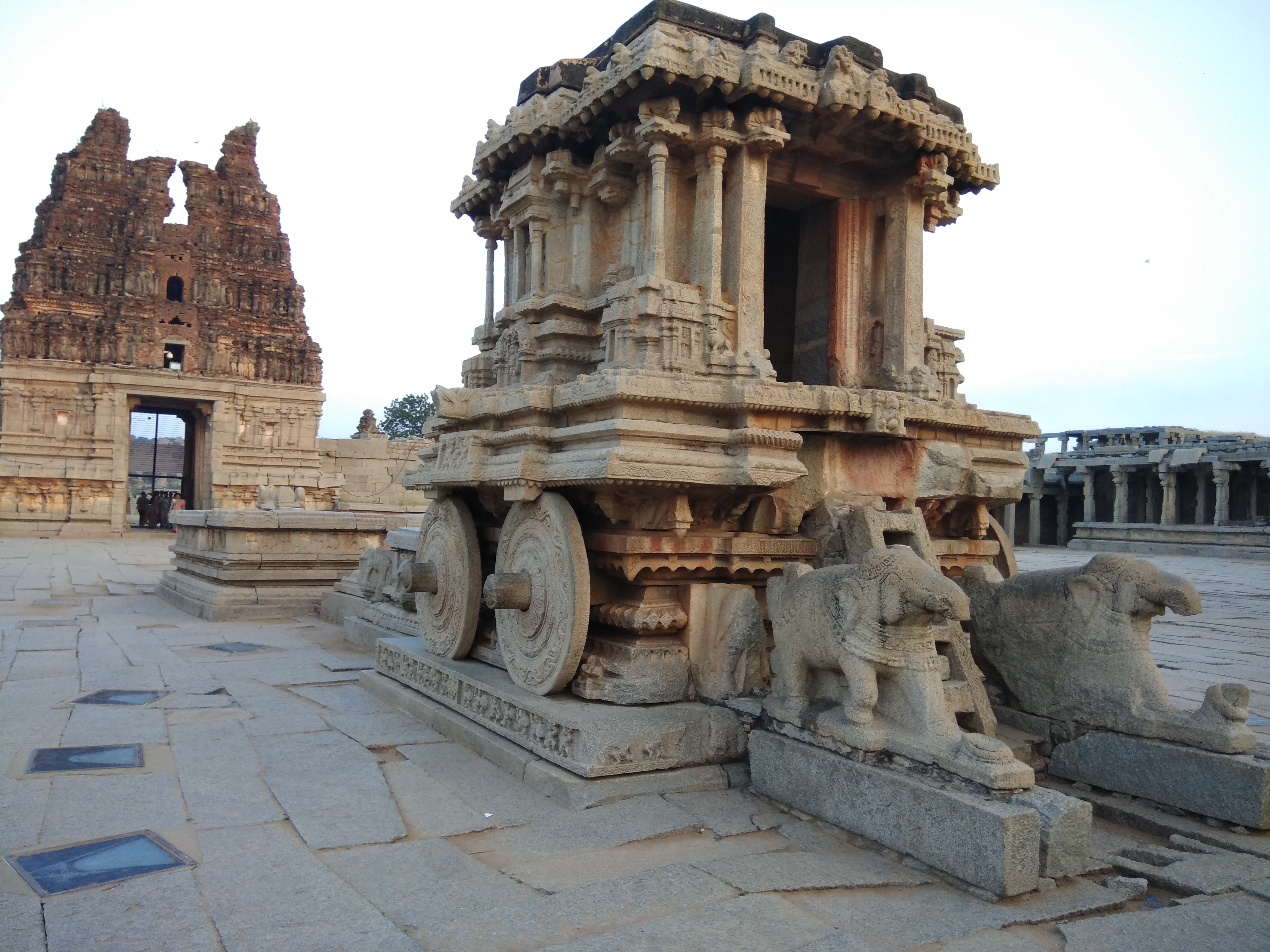
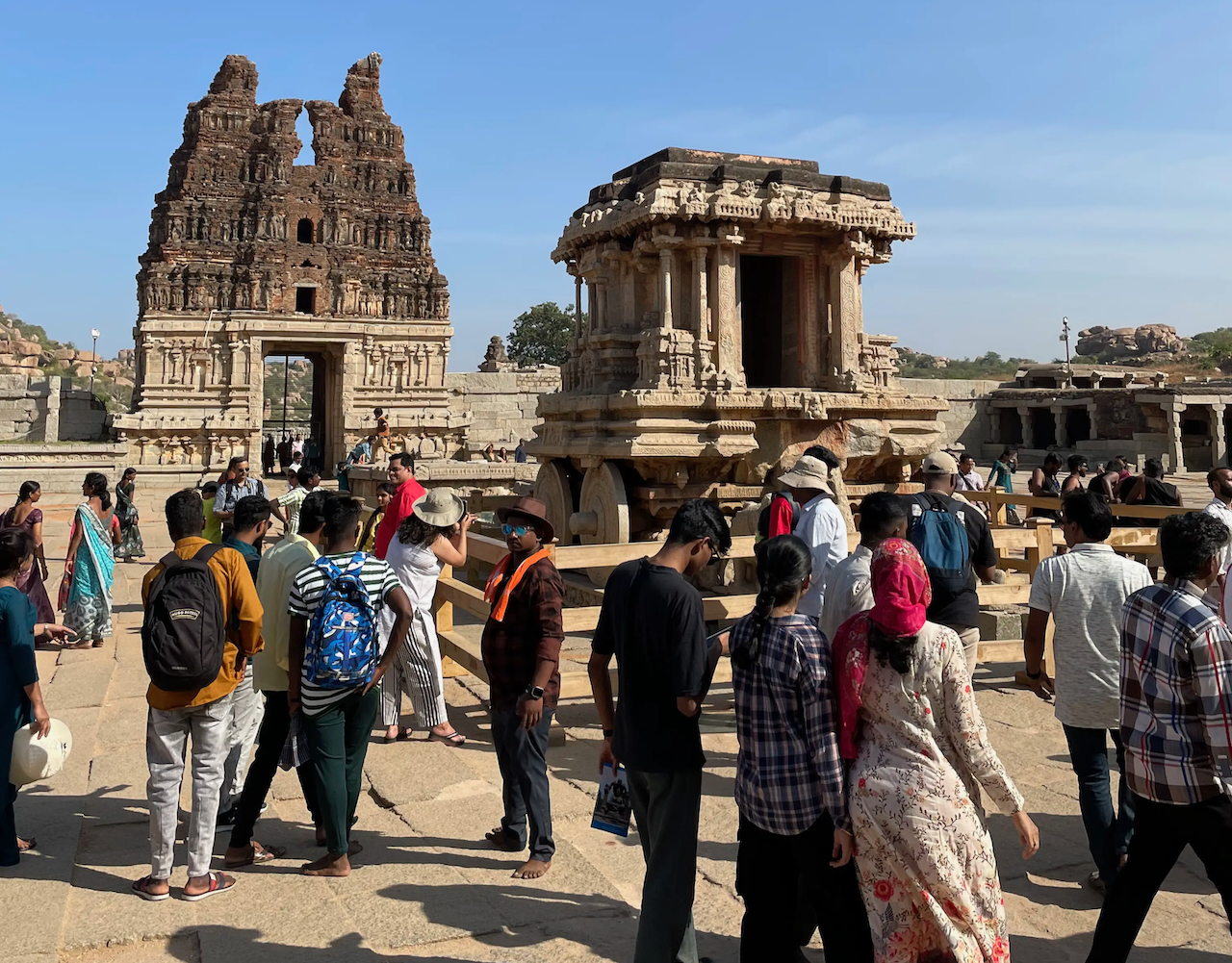
I still have one more day in Hampi. We have booked an autorickshaw that’ll take us to the spots on the other side of the Tungabhadra. For now, I’ll end it here, wishing the newlyweds a happily ever after.
This article is part of a four-part blog series. Here’s the complete list:
- ROAD TRIP (PART 1): FROM KOLKATA…
- ROAD TRIP (PART 2): I EXPERIENCED TOTAL BLINDNESS FOR 2 MINUTES
- ROAD TRIP (PART 3): HAMPI: A TALE OF TWO VISITS
- ROAD TRIP (CONCLUSION): HIGHLIGHTS AND ENDURING MEMORIES
Check out the Instagram page of this trip where Kovid shared the daily highlights.

 Korak Bhaduri
Leave a comment