In January 2022, I did a 30-day project on “Why Your Business Needs to Adapt to Blockchain”. This post is a part of it. To know what I covered, learned, and executed in the project, visit this page.
There can be three cases:
- You are neither familiar with Ethereum nor Logan.
No issues. I’ve got you covered! Continue reading (if you don’t mind spoilers from the 2017 movie Logan). - You are familiar with one.
Cool! By the time you finish reading the article, you’d want to know more about the other. - You are familiar with both.
Read it as a fun piece!
Some Context on the Comparison
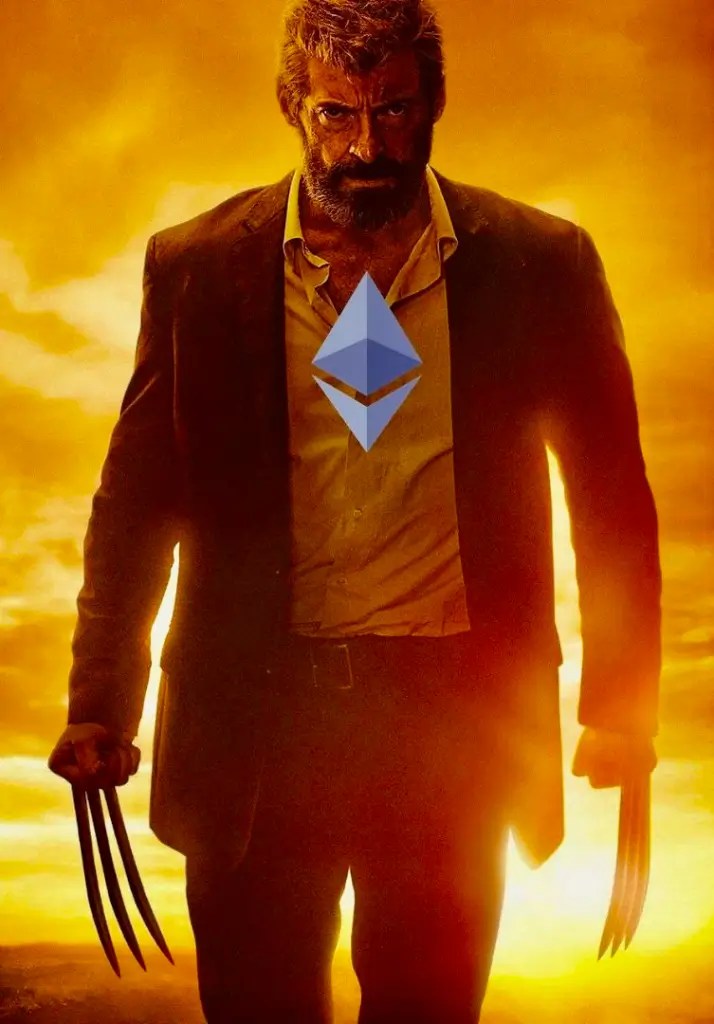
As the month progresses, and I spend more time learning blockchain, strange thoughts and ideas keep popping into my head. In the last couple of days, I started visualizing different blockchain networks as mutants from the 2017 movie “Logan”. Where is the semblance you ask?
Well, in the movie, mutants were few initially. The only two known faces were Professor X (who started X-Men in his Xavier’s School for Gifted Youngsters) and Logan, better known as the ‘Wolverine’. Both were old and at the fag ends of their lives. With time, more mutants started emerging. They were all young, some more powerful and promising than the others. Although mutants had been in the Marvel Universe since ancient times, it was Professor X and his school that gave mutants an identity.
Blockchain too had a similar story. Blockchain technology was first described in 1991 by Stuart Haber and W. Scott Stornetta. Its foundational technologies go back even further into the 70s and 80s pointing to the works of Ralph Merkel or David Schaum. However, blockchain was truly popularized by Satoshi Nakamoto’s whitepaper on Bitcoin in 2008, followed by Ethereum’s whitepaper in 2013. As we know today, Bitcoin and Ethereum are the two largest blockchain networks. New blockchains and altcoins have been launched every year but Bitcoin and Ethereum continue to dominate the market. The promise of the new networks is still unpredictable and the longevity of Bitcoin and Ethereum is questionable.
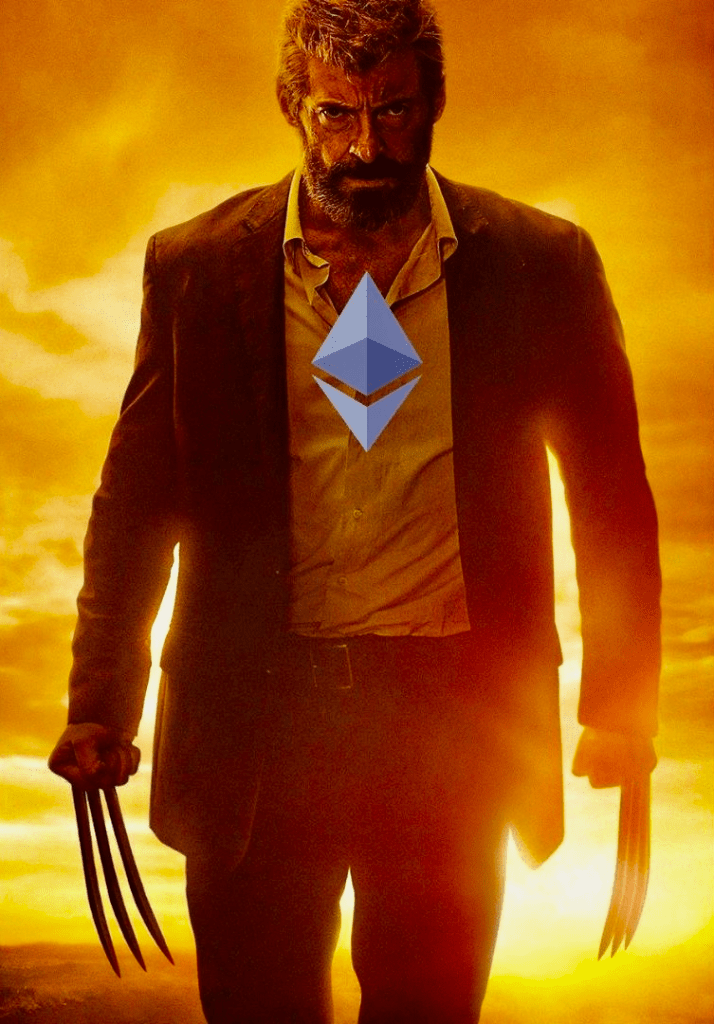
With the above context, I compare Ethereum with Wolverine (but can’t say the same for Bitcoin being Professor X).
So, why is Ethereum old Wolverine?
Reason #1: Ethereum had the major upgrade of smart contracts
Similarity: In addition to his mutant abilities of regeneration and claws, Wolverine’s powers were upgraded by bonding his skeleton with Adamantium.
Bitcoin was the first successful attempt at creating a decentralized digital currency. While Ethereum too enabled a digital currency through its token – Ether, it was much more powerful than the Bitcoin network because it allowed the deployment of smart contracts and building decentralized applications (dApps). This meant that Bitcoin was a mere ledger that noted transactions while Ethereum additionally allowed executable code. Ethereum gave birth to Blockchain 2.0 by separating it from currency and allowing dApps to run on blockchains.

The presence of smart contracts in Ethereum is the biggest difference between the two networks. There are other differences as well, such as their running algorithms: SHA-256 for Bitcoin and Ethash for Ethereum. Also, Ethereum (25 per second) can process transactions much faster than Bitcoin (7 per second). However, despite being faster than Bitcoin, Ethereum is much slower, expensive, and energy-inefficient compared to other Altcoins (alternate coins). The major reason behind these deficiencies is the use of the Proof of Work consensus mechanism to validate the blocks.
Reason #2: Ethereum is inherently secure but smart contracts make it vulnerable.
Similarity: Wolverine’s adamantium made him virtually indestructible. Add that to his mutant ability of regeneration, he became a protector for many life-long. At the same time, Adamantium was slowly killing him from the inside from metal poisoning.
Continuing the last point, although the Proof of Work consensus mechanism makes Ethereum slow and expensive, it brings significant security to the network. Given Ethereum’s popularity and the number of miners it has, performing a 51% attack on Ethereum is next to impossible. A 51% attack is when one single node gains the majority of computing power in a network and can alter the blocks by controlling the transaction consensus. Such an attack may be possible on new or forked cryptocurrencies, but not on Bitcoin or Ethereum.
Ethereum’s adamantium or weakness (and strength) is its smart contracts. The poorly coded smart contracts are the most vulnerable to hacking attacks. In the past, billions of dollars worth of Ether have been lost due to poorly coded smart contracts. A famous example is the siphoning-off of one-third of ‘The DAO’s’ total funds in June 2016.


However, Ethereum’s team has been constantly working to eliminate the blockchain’s vulnerabilities and make it a reliable platform.
Other companies benefit from Ethereum’s size, maturity, and capabilities and launch their tokens on the Ethereum network using Ethereum’s infrastructure. Such tokens are called ERC-20 tokens. Some famous ERC-20 tokens are Chainlink (LINK), Tether (USDT), Basic Attention Token (BAT), etc. Thus, companies need not create their own blockchains and can focus on their core product. Ethereum also boasts some great dApps such as Uniswap or AAVE.
Going back to the problems with smart contracts, smart contracts often rely on off-chain or external resources called Oracles to push information into the blockchain at predetermined times. The network can suffer if there is a problem with an Oracle such as it providing erroneous data or going out of business. A smart contract must account for such an eventuality.
Another problem with smart contracts and blockchain is that once deployed to the blockchain, smart contracts cannot be amended due to their immutable nature. And the more complicated the smart contract, the more likely it will contain vulnerabilities.
But, the biggest problem with having all the smart contracts on Ethereum’s platform is related to its Scalability. That brings us to the third reason.
Reason #3: Ethereum has many copycats

Similarity: X-24 was created as a clone of Wolverine. Its genetic code was altered slightly to exhibit all the rage of Wolverine without his compassion to make it a perfect killing machine.
Ethereum had the revolutionary upgrade of smart contracts on its network that allowed people to run their applications on the blockchain. But, it also had the major problems of low throughput and lack of scalability that made it expensive. A number of blockchains were created to meet the demand for a more scalable Ethereum alternative.
Just like Wolverine’s DNA was used to create X-24 (the younger Hugh Jackman in the pic above), a number of these alternatives were forked from Ethereum. Forking is the coding equivalent of cloning. That is, Ethereum being open source, its code was copied and pasted, and altered slightly to create new blockchains. The changes made the new blockchains faster and cheaper, but often at the cost of decentralization. This brings us to the famous Blockchain Trilemma – the belief that blockchain networks can only provide two of the following three benefits at a time: decentralization, scalability, and security.
These alternatives mostly use novel consensus mechanisms such as Proof of Stake for higher throughput (more transactions per second). Some such networks like Binance Smart Chain, Cardano, Solana, Avalanche, etc. are tipped as Eth-killers.
Reason #4: Ethereum is not a unifying blockchain
Similarity: Wolverine is cool but is a rogue mutant. Although from time to time, he does work with teams and holds responsibility for other mutants, he prefers detachment.
So as I said, Ethereum is slower than its rivals which made the rivals more attractive for developers as platforms. So, developers started developing some great dApps on these rival platforms. But, the problem with each platform is that delays occur and transaction fees increase when too many transactions are submitted at once. So, even if Ethereum is dethroned by one of the rivals, the rival itself won’t last long as it won’t be able to keep up with the future traffic. Moreover, a single blockchain limits a developer to a few programming languages. Developers may prefer one over the other. Developers also have to compromise on the design and efficiency allowed by the blockchain.
The solution to blockchains operating separately offering developers limited options is the Layer 0 protocols. Layer 0 protocols such as Cosmos or Polkadot connect various blockchains and allow them to share data such as tokens, account balance, etc. They also allow customization of blockchains as necessary without going through hard forks or becoming separate chains to accommodate feature upgrades. Additionally, Layer 0 solutions allow entire blockchains to be created on their platforms. All blockchains created thus can communicate with each other. Many such blockchains are created on Cosmos. As a result, developers benefit from more functionality and lower fees.

Professor X of blockchain technology has got to be one of the Layer 0 solutions.
Reason #5: Ethereum, as we know, will probably die in June 2022
Similarity: Although Logan died in the movie, we still have the X-23 girl as the next Wolverine.

Because of the limitations of Ethereum discussed above, Ethereum is getting upgraded to Ethereum 2.0 or Eth 2.0 or Serenity. The main reason behind this is the need to improve throughput and reduce transaction fees. Eth 2.0 is projected to be capable of doing 100,000 transactions per second through a process called sharding. Sharding improves network speed by splitting the network into pieces.
And guess which consensus model Eth 2.0 will have? Proof of Stake. The move to Eth 2.0 started at the end of 2020 and is expected to be complete by summer 2022.
Bonus Reason: The phonetic similarity
Yeah, I know it’s lame. But the words Ethereum and Wolverine sound similar to me, so they are the same. Also, don’t tell me Serenity doesn’t sound like X-23!
If I was able to interest you in Ethereum and blockchain through this article, check out the full project here!
 Korak Bhaduri
Leave a comment